
For many couples, divorce later in life does not come after years of visible conflict. It follows a quieter realization – after children are grown and careers are established or winding down – that the marriage no longer works. This trend, often referred to as “gray divorce,” reflects a shift in how people approach relationships and the next chapter of their lives.
By this stage, the spouses’ lives are often deeply intertwined. Retirement planning, business interests and other complex assets, and financial habits all come into play. Careful planning is especially important for parties divorcing later in life.
Why Gray Divorce is Increasing
While the overall divorce rate has declined, the rate among those over age 50 doubled between 1990 and 2010.1 In 2019, roughly 36% of all divorcing individuals were 50 or older. Why?
The factors that once kept long-term marriages intact have shifted. Americans are living longer and divorce has become less stigmatized, particularly for the baby boomer generation. Financial independence, especially among women, has made leaving marriage later in life more feasible than in prior decades.
The “empty nest” phase can serve as a catalyst, forcing couples to confront longstanding issues. In other instances, disagreements over how to guide young adult children may highlight fundamental differences in goals for retirement and family life.
The Financial Reality of Gray Divorce
Navigating gray divorce requires analyzing current expenses and anticipated long-term costs to plan for the future as a single person. Many couples over age 50 have accumulated wealth in retirement accounts, real estate, and closely held business interests – valuable assets that are often not easily converted to cash. At the same time, there is typically a limited earning runway to rebuild financially, which often makes liquidity, tax consequences, and long-term cash flow important.
Decisions about who keeps which asset, how retirement funds are divided, who will retain control over business interests, and whether support is necessary directly impact financial security for both parties.
Business and Complex Asset Division
When a closely held business has been developed over decades, it is usually worth more than its fair market value. It is tied to income, identity, and financial security. Determining how to value and divide business interests, professional practices, or interests in private equity or partnerships requires careful analysis. One spouse may wish to retain the business, but doing so can leave that party with offset obligations or concentrated risk. At the same time, dividing assets like real estate portfolios can create liquidity pressures that are not immediately obvious, especially in a dynamic market. In gray divorce, the structure of property division becomes critical to ensuring both parties can maintain financial stability in the next stage of their lives.
Retirement Accounts in Gray Divorce Cases
Retirement accounts are critical in gray divorce cases. There are two general types of retirement plans: defined benefit plans and defined contribution plans. Defined benefit plans, such as pension plans, provide a specified monthly payment. Defined contribution plans, such as a 401(k), are based on contributions. Under Texas law, both types of plans are community property if acquired during the marriage, so they are subject to division in a divorce.
While retirement plans are divisible in divorce, dividing them is not as simple as distributing the funds in a checking account. Most retirement plans must be divided pursuant to a specialized order called a Qualified Domestic Relations Order (“QDRO”), which directs the plan administrator to pay a portion of the benefits to an ex-spouse.
Support and Long-Term Planning
When long marriages end, alimony – often referred to as spousal maintenance in Texas – frequently comes into play. Although parties can agree to contractual alimony, a court may order spousal maintenance only when certain criteria are met. (See the summary below.) There are also limitations on the amount and duration of payments.2
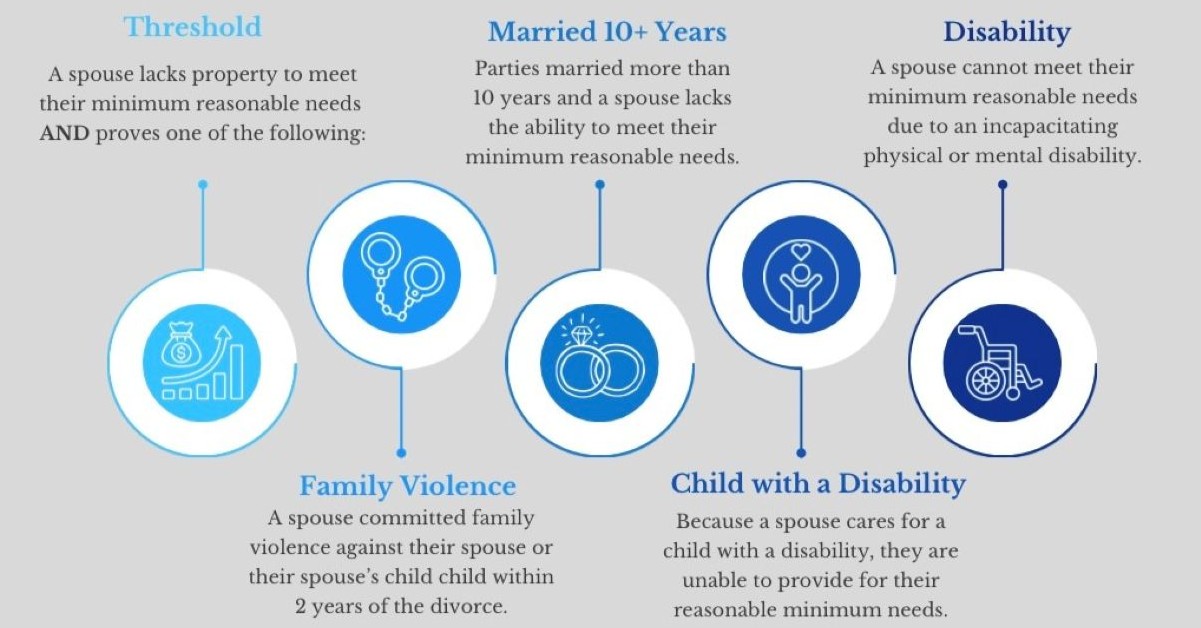
Diagram of criteria considered for spousal maintenance.
Moving Forward
The emotional transition between long-term marriage and single life post-50 can be challenging, but it can also be rewarding. Many individuals discover new hobbies, rekindle old friendships, and rediscover interests they had neglected during marriage. It can be exhilarating to rediscover independence and autonomy later in life. For those who struggle with loneliness or grief post-divorce, mental health professionals and divorce support groups can be helpful.
Takeaway
Gray divorce is not just the end of a marriage; it is a restructuring of the next phase of life. The decisions made during this process will shape financial security, family relationships, and long-term stability for years to come.
—–
- https://www.aarp.org/family-relationships/gray-divorce-trend/
- Link to: https://www.cowlesthompson.com/resources/practice/family-law/what-about-alimony-spousal-maintenance-in-texas/